
Coupon Statistics: Usage Stats For 2026
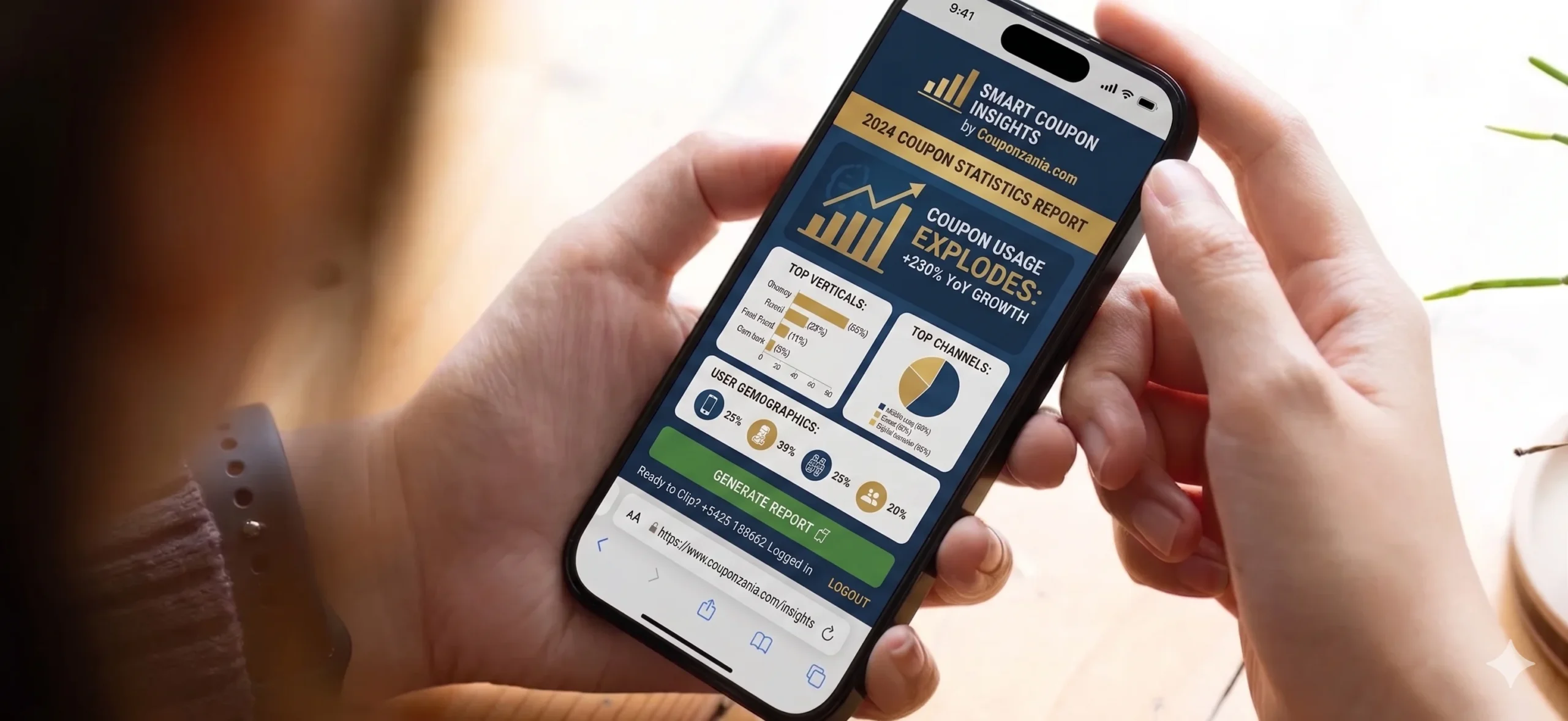
The global digital coupon market crossed $10.57 billion in 2025 and is projected to reach $12.59 billion in 2026, growing at a compound annual rate of 19.15% through 2035. That trajectory is not driven by marketing budgets alone. It is driven by a fundamental change in how consumers approach every purchase decision, from weekly grocery runs to international travel bookings.
Over 90% of consumers have used at least one coupon in the past twelve months. More than 169 million Americans redeemed a digital coupon in 2025 alone. This article consolidates the most current data on coupon usage, redemption behaviour, platform preferences, and market growth so you have a single, authoritative reference for 2026.
Section 01Market Size and Growth Trajectory
The digital coupon sector is one of the fastest-growing segments within the broader e-commerce economy. After reaching $8.87 billion in 2024, the market expanded to $10.57 billion in 2025 and is on course to exceed $12.59 billion by the close of 2026. Industry forecasts project the market will surpass $57 billion by 2035, representing a near sixfold increase from current valuation.
Projected Market Size by Year (USD Billions)
The growth is underpinned by three structural forces: rising smartphone penetration, the maturation of AI-driven personalisation engines, and a permanent post-pandemic preference for digital-first commerce. A 35% rise in digital coupon adoption over the past five years confirms the shift is not cyclical but structural.
Section 02Global Coupon Market Share by Region
North America leads the global coupon market but the competitive landscape is shifting as Asia-Pacific economies accelerate their digital commerce infrastructure. Over 71% of buyers across the Asia-Pacific region use coupons during online shopping sessions, reflecting the depth of deal-seeking behaviour outside North America.
Europe contributes 27% of global coupon market share, largely driven by QR-code redemptions and integrated digital wallet programmes. The Middle East and Africa, while currently the smallest segment at 10%, are the fastest-growing zone by adoption rate as smartphone penetration expands. Over 48% of online buyers in the region already use coupons during purchases, a figure rising consistently year over year.
Section 03Key Coupon Usage Statistics for 2025 and 2026
The data below consolidates the most reliable figures from market research firms and consumer behaviour studies published in 2025 and early 2026. Each statistic represents either a direct survey finding or a tracked redemption metric from aggregated platform data.
- Over 90% of consumers globally have used a coupon at least once, with 91% of American shoppers alone accounting for 262.5 million individual coupon users.
- 62% of U.S. consumers actively search for promo codes and discounts before completing an online purchase, making deal-seeking a standard part of checkout behaviour.
- 169.2 million Americans redeemed a digital coupon in 2025, up from 142 million in 2020, reflecting consistent year-on-year growth in the active redeemer population.
- 85% of shoppers have abandoned a shopping cart specifically because they could not find a coupon code during checkout.
- 66% of consumers have made an unplanned impulse purchase solely because they encountered a digital coupon during browsing.
- 79% of consumers will provide their email address in exchange for access to a digital coupon, making discount offers the single most effective email list growth mechanism available to retailers.
- Consumers who use coupons spend 18% more on average than those who do not, and retailers using coupons report up to 24% higher spending from coupon-influenced sessions.
- 85% of consumers are willing to share personal data with retailers in exchange for targeted discounts, with 90% specifically willing to provide their email address.
- 93% of consumers are likely to make a repeat purchase from a brand that offered them a relevant discount, confirming the retention value of coupon-based marketing beyond single-transaction acquisition.
- The coupon redemption rate increased 10.4% in 2023 versus 2022, marking the first year-on-year increase since 2008 and signalling a structural upturn in redemption behaviour.
How Shoppers Discover Coupon Codes
Understanding where consumers find coupons determines where retailers should concentrate their distribution investment. Brand emails lead all channels at 47%, closely followed by search engines and coupon aggregator websites. Platforms like CouponZania sit squarely in the coupon aggregator category, which captures 44% of discovery traffic globally and remains one of the highest-intent channels because users arrive already committed to finding a deal.
Coupon Discovery Channel Share
Search engines and coupon websites are now statistically tied as the second and third most used discovery channels, each capturing between 44% and 48% of coupon-seeking sessions. The practical implication is that coupon aggregators with strong organic search visibility effectively capture demand from both channels simultaneously, since a significant portion of search queries for discount codes resolve to aggregator pages.
Mobile Coupon Statistics: Smartphones Now Dominate
Mobile devices have become the primary instrument for both discovering and redeeming coupons. In 2025, 93.5% of digital coupon users accessed and redeemed offers via smartphone, with tablet usage trailing significantly at 41.9%. Mobile coupons are now redeemed at rates ten times higher than traditional paper equivalents.
- 93.5% of digital coupon users in the U.S. redeem offers using a smartphone. This figure is expected to rise to 93.8% by 2026 as smartphone penetration deepens in remaining age cohorts.
- 35% of consumers actively use digital coupons while shopping inside physical stores, using their phone to apply a code at the point of sale or self-checkout terminal.
- 68% of consumers prefer receiving coupon offers directly through mobile apps over other delivery formats, and 65% rely on apps as their primary gateway to promotional offers.
- 45% of coupon redemptions now occur via push notification, reflecting how app-based retargeting has become a high-conversion distribution format for time-sensitive promo codes.
- 69% of Black Friday 2024 transactions globally occurred on mobile devices, and mobile traffic drove 79% of all e-commerce visits during Cyber Week. Any coupon strategy that is not mobile-optimised is structurally disadvantaged during peak shopping periods.
- 38% of marketers now integrate AI and machine learning into their coupon targeting systems, enabling personalised discount delivery at scale and reducing wasted redemption spend.
Coupon Usage by Generation
Coupon behaviour varies significantly across generations, not only in format preference but in the psychological triggers that drive engagement. Millennials remain the most deal-responsive cohort, but Gen Z is closing the gap rapidly, with 85.5% of Gen Z shoppers waiting for a coupon offer before finalising a purchase decision.
Brand Switching Likelihood When a Coupon is Offered
Gen Z’s pre-purchase search behaviour is particularly significant for retailers. 78% of Gen Z shoppers actively look for a discount code before hitting the payment button on any digital transaction. This cohort has integrated deal-seeking into its standard checkout routine in a way that previous generations did not, making coupon availability a near prerequisite for conversion rather than a bonus incentive.
Section 07Digital vs Paper Coupons: Redemption Data
Digital coupons now account for one-third of all coupon redemptions globally, while traditional free-standing newspaper inserts represent 24.2% and instant redeemable coupons at checkout make up 15.3%. The format shift is structural and generationally driven. 57% of U.S. shoppers now prefer digital over paper as their primary coupon format. You can read a deeper breakdown in our guide to digital coupons.
| Format | Share of All Redemptions | Key Metric |
|---|---|---|
| Digital coupons (all forms) | 33.3% | 7%+ average redemption rate |
| Free-standing inserts (print) | 24.2% | Declining year on year |
| Instant redeemable (in-store) | 15.3% | Stable; grocery-concentrated |
| Mobile coupons specifically | ~80% of digital total | 10x redemption rate vs paper |
| E-coupons (email/app codes) | 46% of digital segment | Fastest-growing sub-format |
| Online promo codes | 36% of digital segment | Most searched at checkout |
The AI-driven personalisation layer is a decisive advantage for digital formats. Retailers can generate and distribute targeted promo codes within 24 to 48 hours of identifying a behavioural trigger, versus print campaigns that require planning cycles of days to weeks. 38% of marketers have already integrated AI into coupon personalisation workflows, and that figure is accelerating alongside broader adoption of retail media technology.
Section 08Coupon Usage by Shopping Category
Coupon penetration and average discount depth vary significantly across retail categories. Food, grocery, and fashion consistently show the highest redemption volumes due to repeat purchase frequency, while software and digital services offer the deepest percentage discounts due to their near-zero marginal cost of delivery.
Share of Online Shoppers Using Coupons by Category
Grocery coupon usage is growing fastest in percentage terms. 33% of U.S. grocery shoppers increased their coupon usage in 2025, up from 26% in 2023. Food delivery remains the most search-intensive coupon category globally. The query “DoorDash promo code” is consistently the most searched coupon-related term across all retail categories, reflecting the scale and frequency of food delivery ordering.
| Category | Avg. Discount Range | Dominant Code Type | Peak Period |
|---|---|---|---|
| Food Delivery | 20% to 40% | % off, free delivery | Year-round, highest on weekends |
| Fashion & Apparel | 15% to 30% | Seasonal, flat value | End-of-season, Black Friday |
| Electronics | 5% to 31% | Bundle, cashback | Cyber Monday, Prime Day |
| Travel | 10% to 25% | Member-only, last-minute | Off-peak, flash sale windows |
| SaaS and Software | 20% to 50% | Annual plan, first-year | Year-end, product launch cycles |
| Grocery | 10% to 20% | BOGO, loyalty-linked | Weekly, continuous availability |
Most Visited Coupon Websites in 2025
The top five coupon websites in the U.S. received a combined 383.4 million global monthly visits in 2025. Globally, Rakuten leads all coupon platforms with 17.7% of total coupon site traffic, receiving 222.4 million monthly visits as of late 2025. Slickdeals ranks first specifically in the U.S. market with 16.2% of domestic coupon traffic and 76 million global visits.
CouponZania is a global deals platform covering promo codes, verified discounts, and cashback offers across grocery, travel, electronics, fashion, health, finance, software, home, entertainment, and education. Every code is audited before it goes live, and the catalogue covers 3,000+ stores updated daily. For shoppers planning purchases across the retail calendar, the CouponZania Sale Calendar maps every major discount window by month so no peak savings period goes missed.
Top Global Coupon Platforms by Monthly Traffic (2025)
44% of coupon seekers visit dedicated aggregator websites to find discount codes, making coupon platforms a critical distribution layer between retailers and high-intent shoppers. The platforms with the strongest performance invest in structured data, real-time code verification, and programmatic page creation to match the search queries consumers enter at the point of deal-seeking.
Section 10Seasonal Coupon Trends and the Best Months to Shop
Coupon availability and average discount depth follow a predictable annual cycle. October, April, and May historically show the highest volume of available codes, while November delivers the deepest average discounts of any month due to the concentration of Black Friday and Cyber Monday promotional budgets. Shoppers who track the retail calendar systematically access both more codes and higher-value savings windows. The CouponZania Sale Calendar tracks all major sale events globally so you can plan purchases around peak discount periods.
| Month | Primary Shopping Occasion | Code Volume | Average Discount Depth |
|---|---|---|---|
| January | Post-holiday clearance, New Year sales | High | Moderate to High |
| February | Valentine’s Day, winter clearance | Moderate | Moderate |
| March | Spring sales, Ramadan (variable year) | Moderate to High | Moderate |
| April | Spring clearance, Easter promotions | Very High | Moderate to High |
| May | Mother’s Day, mid-year lead-in | Very High | High |
| July | Mid-year sales, Prime Day adjacent | Very High | High |
| September | Back to school, early holiday stocking | High | Moderate |
| October | Pre-holiday campaigns, Singles Day build-up | Peak | High |
| November | Black Friday, Cyber Monday, Singles Day | Peak | Deepest of the year |
| December | Christmas, end-of-year gifting | Very High | High |
How Coupons Change Consumer Behaviour
The behavioural impact of coupons extends far beyond simple price reduction. Coupons function as trust signals, acquisition tools, and retention mechanisms simultaneously. 83% of consumers globally say coupons directly influence what they buy, when they buy, and which brand they choose. That influence operates across the entire purchase funnel from initial discovery to repeat purchase.
- 39% of shoppers say they are more likely to try a brand they have never purchased from before when a coupon is offered, making discount codes one of the most cost-effective new customer acquisition channels in retail.
- 67% of shoppers report making an unplanned purchase because they found a discount, confirming that coupons reliably increase basket size beyond the discounted item itself.
- 85% of digital coupon users redeem their code within one week of receiving it, and 30% redeem on the same day they receive the offer, indicating strong short-term conversion behaviour.
- 48% of U.S. consumers say they are more likely to complete a purchase sooner than planned when a coupon is available, accelerating the conversion timeline for retailers.
- 51% of consumers share digital coupon codes with friends and family, creating an organic distribution multiplier for every code a retailer publishes or distributes.
- 67% of shoppers prefer percentage-off discount formats, while 61% respond positively to buy-one-get-one-free structures. Fixed value discounts appeal most to higher-ticket category purchases.
- 93% of shoppers say a coupon must offer at least 10% off to be considered worthwhile. Codes below this threshold generate low engagement and high abandonment at the checkout stage.
- 50% of consumers use digital coupons occasionally, and 22% rely on them for almost every purchase they make, indicating that heavy-use couponers represent a stable and predictable segment of the retail audience.
The History of Coupons: From Coca-Cola to Algorithmic Discounting
The coupon as a commercial instrument has a clear origin point in 1887 when Asa Candler distributed the first documented promotional voucher for a free glass of Coca-Cola. Between 1894 and 1913, the company redeemed an estimated 8.5 million free glasses through the campaign, establishing a model that competitors rapidly replicated across food and packaged goods categories.
Asa Candler creates the first commercial coupon for Coca-Cola. A handwritten voucher entitles the bearer to one free glass, launching the concept of discount-as-acquisition-tool in mass consumer retail.
The Great Depression accelerates coupon adoption across grocery, household goods, and staple food categories. Brands use discount vouchers to sustain volume during widespread consumer income contraction.
The U.S. government repurposes the coupon format as a rationing mechanism during World War II, issuing vouchers that authorise access to sugar, flour, and dairy at a time of supply constraint.
The Nielsen Coupon Clearing House opens as the first business dedicated entirely to coupon processing, standardising the redemption infrastructure between manufacturers and retailers at national scale.
More than half of all American households use coupons regularly, marking the transition of coupon redemption from a marginal behaviour to a mainstream component of household budget management.
The first coupon aggregator websites appear alongside early e-commerce, collecting and publishing online promo codes at scale. Platforms like Slickdeals and RetailMeNot establish the aggregator model that now receives hundreds of millions of monthly visits.
The COVID-19 pandemic permanently accelerates the shift to digital and mobile coupon formats. AI-powered personalisation, browser extensions, and savings apps create a real-time discount layer across the global e-commerce ecosystem. The market triples in value within five years.
Over 90% of coupon platforms are expected to offer AI-driven personalised recommendations. QR-code redemptions, gamified offer formats, and AR-enabled discount experiences represent the next wave of coupon delivery innovation.
Takeaway
Coupon usage is universal, mobile-first, and accelerating. The global digital coupon market is valued at $10.57 billion in 2025 and will exceed $57 billion by 2035. Over 90% of consumers use coupons, 93.5% redeem via smartphone, and the average household saves $1,465 annually when coupon usage is consistent and strategic.
The data is unambiguous for retailers: coupon strategy and digital infrastructure are no longer separable decisions. For consumers, the tools for maximising savings on every category have never been more accessible or more effective.
Find verified, audited codes across grocery, food delivery, electronics, fashion, and travel at CouponZania, and use the Sale Calendar to plan your purchases around the peak discount windows of the year.